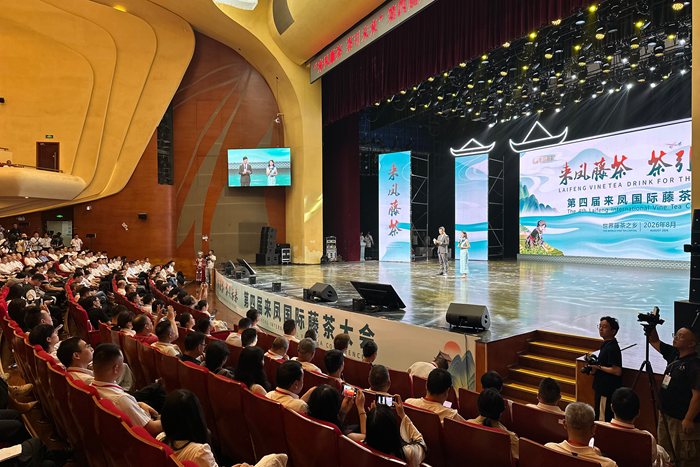
The 4th Laifeng International Vine Tea Conference, themed “Laifeng Vine Tea, Drink for the Future,” kicked off in Laifeng County, Enshi Tujia and Miao Autonomous Prefecture, Hubei Province, on August 1. Diplomatic envoys to China, overseas business representatives, domestic experts and scholars, as well as representatives from industry associations and leading enterprises, gathered by the Youshui River to discuss opportunities for industrial cooperation and jointly explore pathways to high-quality development.
Zhai Huqu, former President of the China Association for the Promotion of International Agricultural Cooperation (CAPIAC) and former President of the Chinese Academy of Agricultural Sciences, announced the opening of the conference. Jia Guangdong, CAPIAC President, Yang Shengliao, Vice Governor of Enshi Prefecture, and Wang Bing, Secretary of the CPC Laifeng County Committee, delivered remarks.
In his speech, Jia Guangdong noted that China’s vine tea cultivation area has surpassed 400,000 mu (approximately 26,667 hectares). The approval of polyphenols extracted from Ampelopsis grossedentata leaves as a new food ingredient has created new opportunities for the vine tea industry. Vine tea is now expanding beyond traditional tea consumption to serve as a standardized functional ingredient in beverages, baked goods, and health products. As a distinctive tea category beyond China’s six traditional tea types, vine tea is leveraging its functional properties and standardized production to unlock new growth potential. It is not only emerging as a promising driver of consumption growth but also a pacesetter in promoting the high-quality development of China’s tea industry by capitalizing on its unique advantages.
At the opening ceremony, Qiao Shiyan, Member of the Chinese Academy of Engineering (CAE) and professor at China Agricultural University; Jin Meilin, CAE Member and professor at Huazhong Agricultural University; and Wei You, Executive Vice President and Chairman of the Trade Union of CAPIAC, shared their perspectives on the development and applications of Laifeng vine tea products. Drawing on their own research and industry experience, the two CAE members offered insights into the future of the vine tea sector, while Wei You shared his views on developing a wide range of value-added processed products and building stronger market demand.
Experts also highlighted the latest achievements in industry–academia–research collaboration, covering areas such as vine tea germplasm development, sustainable cultivation practices, pharmacological research on bioactive compounds, anti-aging product development, deep processing across the entire industrial chain, and sustainable pest and disease prevention and control.
At the conference, a series of group standards were released, including Technical Specifications for Regional Trials of Vine (Mei) Tea Varieties; Vine Tea; and Vine Tea Processing Technologies. In addition, the 2026 Research Report on the Brand Influence Index of China’s Regional Public Tea Brands was released.
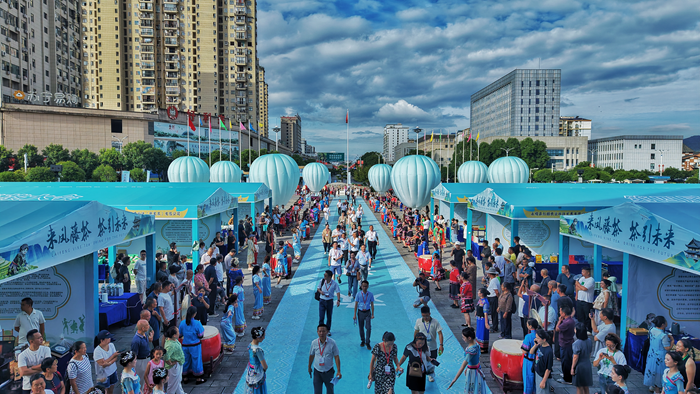
On the same day, a national exhibition and trade fair featuring vine tea products was held at Longfeng Cultural Center Square in Laifeng County. More than 80 enterprises from Laifeng and beyond exhibited intangible cultural heritage craftsmanship, innovative tea beverages, and achievements in cross-border cooperation.
The International Vine Tea Conference has been held in Laifeng County for four consecutive years. In recent years, Laifeng has made vine tea a pillar industry for increasing residents’ incomes and strengthening the county’s economy, while continuously improving the entire industrial chain. The county now has more than 110,000 mu (approximately 7333 hectares) under vine tea cultivation, generating RMB 2.53 billion in output value in 2025. It has developed a complete closed-loop industrial chain integrating standardized cultivation, deep processing, scientific research and innovation, e-commerce and cultural tourism, and cross-border trade. Laifeng is home to 91 vine tea enterprises and 46 processing facilities, with 45 vine tea-related patents. Its product portfolio extends across tea beverages, personal care, health and wellness, food, and other sectors.
 No.11 Nongzhanguan Nanli,Chaoyang District,Beijing China (100125)
